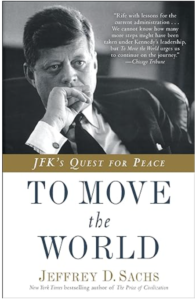
Inspiring Interview with Professor Jeffrey Sachs About His Book, “To Move the World: JFK’s Quest for Peace”
In the course of Chris Hedges’ interview (video below) Professor Jeffrey Sachs recounts JFK’s experience with the Cuban Missile Crisis:
“And as soon as Kennedy saw the U-2 spy plane over Cuba taking these pictures of missile sites, he convened an executive committee, ExComm, and it was almost unanimous. Well, we got to shoot down these sites, we have to take them out before they can be deployed. And it was unanimous essentially that there needed to be an immediate war and the Joint Chiefs were told to go off and plan the military campaign against Cuba. Would it be an air campaign? Would it just be to take out the sites? How many troops would be needed? And so forth. Kennedy, interestingly, to make a very long story short, had lunch by coincidence with Adlai Stevenson, the US Ambassador to the United Nations, on the first day of the Cuban Missile Crisis when Kennedy had seen the pictures. And Adlai Stevenson said to Kennedy, well, of course you need diplomacy to end this and exchange the missiles with the Turkish missiles. Kennedy was shocked because no other advisor had said anything about diplomacy. It was basically unanimous for a military approach, which by the way almost surely may be too strong, although I’m not sure it is, but most likely would’ve led to nuclear annihilation. Because our doctrine was that if we were attacked by a nuclear weapon, we would give a full response. By the way, “full” meaning not only the Soviet Union but Eastern and Central Europe, China, hundreds of millions of people killed. And now we learned afterwards from the nuclear winter, maybe all of humanity perishing from starvation afterwards. But Stevenson laid the idea of maybe a negotiated settlement. Well, to make a long story short, as people know, Kennedy really almost alone though with this hint from Stevenson and then with his brother Robert pushing and Ted Sorensen pushing and a few others pushing, turned the tide over a few days that, don’t do something precipitous, let’s try to figure out what’s in Khrushchev’s mind. And Kennedy came to realize, because he had people like the Air Force head, Curtis LeMay, who just wanted nuclear war it seems or first strike against the Soviet Union, that he was surrounded by a lot of hotheads who could end the world. And he realized Khrushchev probably was as well. And the two of them came to realize, we better tamp this down. And they did. ”
[…]
” … that was one of the episodes that brought us to the brink of nuclear annihilation. But there was one even more dramatic, which was that after the agreement was reached between Kennedy and Khrushchev, there was a disabled [Russian] submarine in the Caribbean that was part of a squadron and it was the one in that squadron that carried nuclear tipped torpedoes. And when that disabled sub rose, normally the US might drop depth charges on the submarine to get it, to force it to rise. But a jackass, I think is the right technical term, dropped live hand grenades as he was flying over this rising submarine and the skipper thought, our sub is under attack, there must be war. [Hedges: ‘This was a Russian submarine?’] Sorry, Russian submarine, that was my point, disabled Russian submarine, excuse me. And they thought they were under attack and that there must be a war at the surface. It was disabled and out of communication. And so the captain of the vessel ordered that the nuclear tipped submarine be loaded into the torpedo bay and that it be fired. And if it had been fired, under US nuclear doctrine, being attacked by a nuclear weapon, including a nuclear tipped torpedo, under US doctrine would have launched that full scale response that would have destroyed humanity. And the order to fire was countermanded at the last moment by virtue of the fact that there happened to be a Soviet party official who was senior to the captain of the vessel who said, I don’t think it’s a good idea. We should rise without firing. And they did, and it turned out there wasn’t a war on the surface and there wasn’t a need to launch the torpedo. We came within a second of ending the world and that was after the agreement had been reached between the USSR and the United States. And Martin Sherwin, the late historian who now people know as the person who co-wrote the great book American Prometheus on J. Robert Oppenheimer, wrote this story in his wonderful last book before he passed away, “Gambling with Armageddon,” which is a history of the Cuban Missile Crisis. Absolutely phenomenal. As is “American Prometheus.” And they’re both great books. He wrote that with Kai Bird, of course. You can visit that submarine. I think it’s in San Francisco. I did. The Russian Submarine is a museum. So Kennedy walks away from this horrified at how close the world came to nuclear Armageddon, but he also walked away with a deep distrust of the military.”
These incidents are also discussed in Sachs’ book. But the central theme of his book was JFK’s initiatives to cool down the Cold War by working with Khrushchev and Kennedy’s “Peace Speech” in June of 1963 that expressed much of what he had learned from his mistakes leading up to the Cuban Missile Crisis.
Here’s the interview, an inspiring discussion:
What JFK tried to do before his assassination w/Jeffrey Sachs | The Chris Hedges Report
RELATED (BOOK):